Jonathan Haidt’s The Anxious Generation has been one of those recently. It has sparked important conversations about young people, technology, and how our environments shape behaviour. One observation that stayed with me was his description of how children gradually disappeared from public spaces (the slow demise of the playground), and how much more life moved indoors.
Reading it prompted me to return to an earlier book of his: The Righteous Mind.
It was published quite some time ago, but it feels remarkably relevant when thinking about conversations, judgement, and how people change their minds.
One idea in particular stood out again. Haidt describes the relationship between intuition and reasoning through the metaphor of the elephant and the rider. The rider represents our reasoning mind, while the elephant represents our intuitive, emotional responses. We often assume the rider is in charge. In reality, the elephant usually moves first.
I’ve been using that metaphor for years when working with teams around challenging conversations. When someone is strongly in their emotions, trying to reason your way through the situation rarely works. The rider cannot simply force the elephant to move.
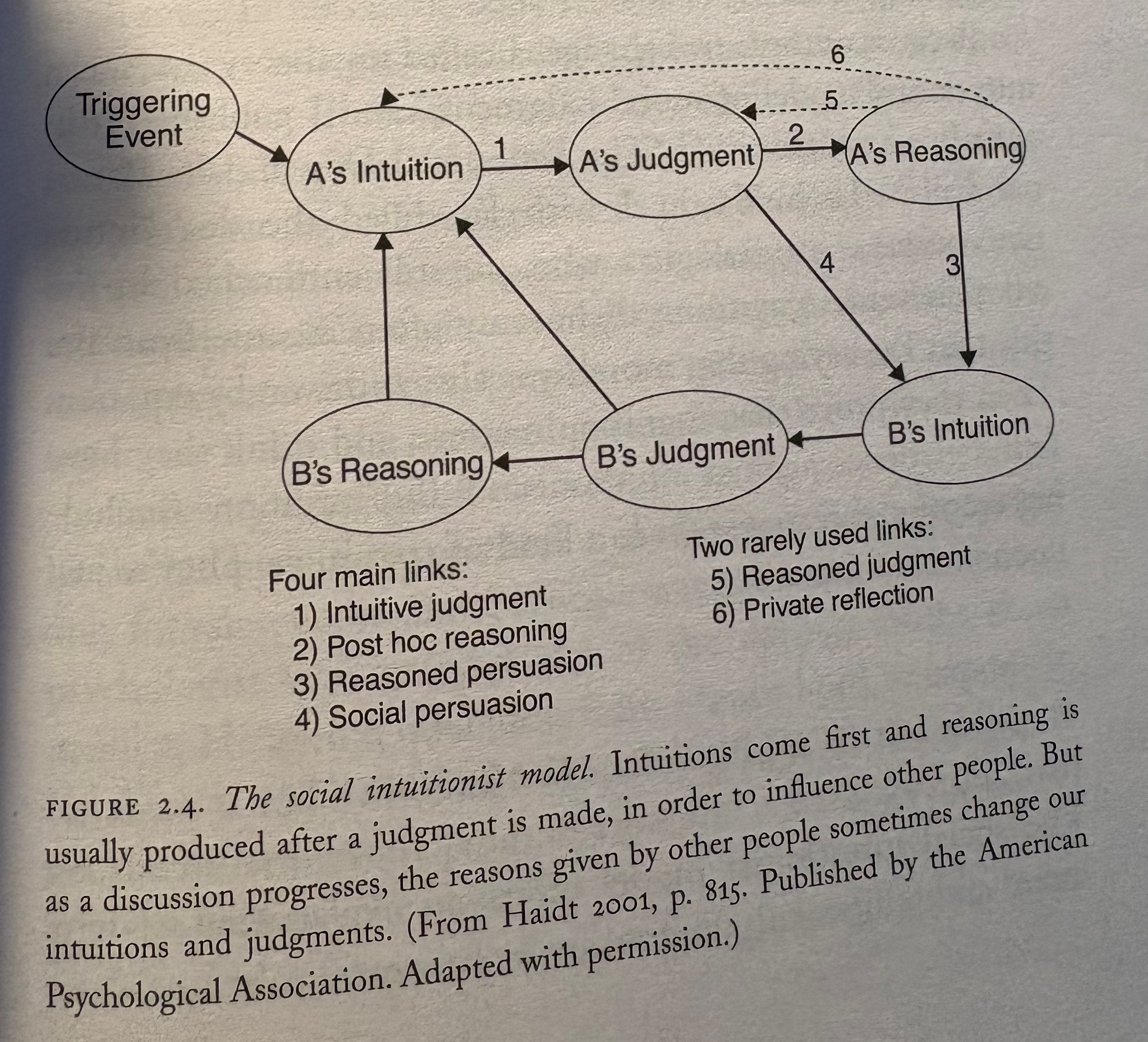
What I appreciated in The Righteous Mind is how much deeper Haidt goes. He describes how our initial intuitions shape our judgments almost instantly, and how reasoning often follows afterwards, mainly to explain or defend the conclusion we’ve already reached. But there is an important twist to this. Change rarely happens through private reasoning alone. It happens in conversation. Someone asks a question, someone offers a perspective we hadn’t considered, and gradually our intuition shifts. Only then does the rider follow.
That idea resonates strongly with what I often see in teams. Better decisions rarely come from individuals reasoning harder on their own. They emerge from conversations where people feel able to question assumptions, challenge thinking, and explore different perspectives together. In many ways, that is the work I describe as Better Thinking Together; creating the conditions where conversation can genuinely expand how people understand a situation. Which makes the quality of those conversations incredibly important. Because if we want better thinking in organisations, we don’t just need better arguments. We need better conversations.
The diagram in the book illustrates how judgement, intuition and reasoning interact in discussion.
I’m curious: when have you experienced a conversation that genuinely changed how you saw something?