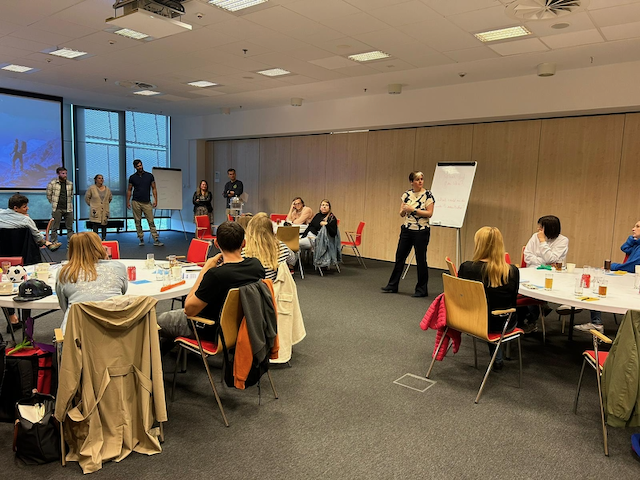
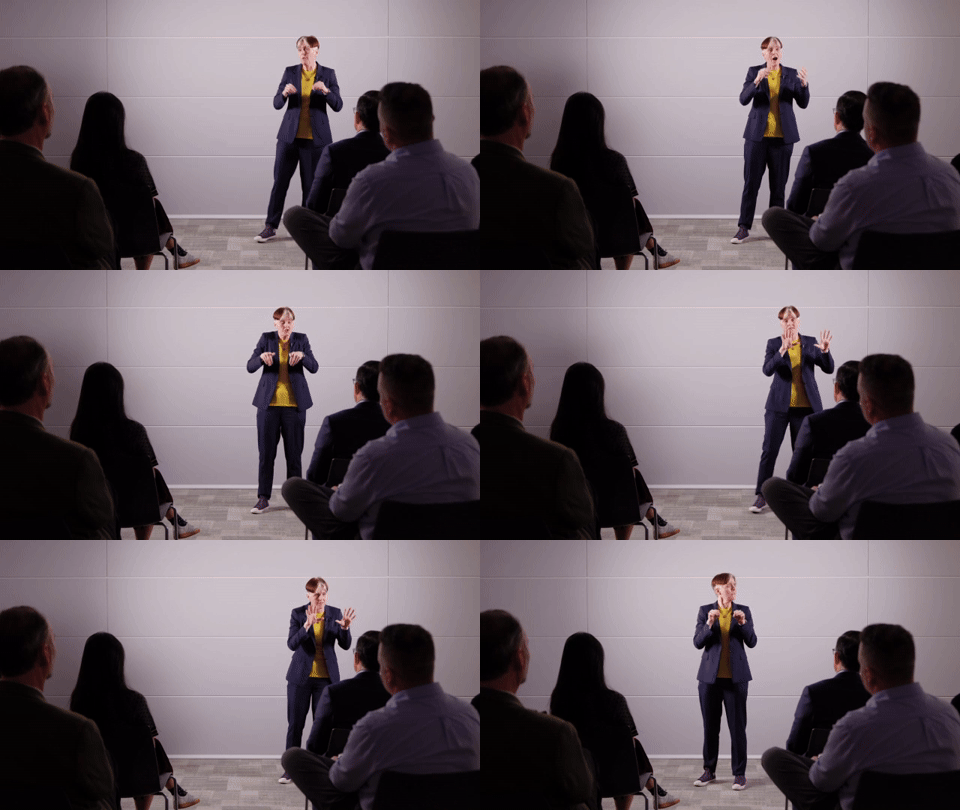
Mostly by showing you where yours went.

Last December I was asked to do something I rarely do in my work. Prepare something for myself. A short talk. A few minutes. Simple, in theory.

I was in a hotel room outside New York. Cold, because the heater was too noisy to leave on. 11pm. A full day of training behind me. Another full day ahead.

And I sat down to write.

Nothing came.

I have spent years helping others find their story, get to the point, say the thing they actually mean. I know how this works. I know what blocks it. I know what unlocks it.

And still. Nothing.

At some point, in frustration, I typed exactly that into a conversation with an AI. Something like: why is this so hard, it should be easy by now.

The response stopped me:
“What you’re experiencing is not a lack of ideas. It’s too much perspective. When you’ve coached for years, reflected deeply, helped hundreds of people articulate their moments of growth, your brain no longer reaches for neat stories. It scans for truth. And truth is messier, quieter, and harder to pin down in two minutes. That’s not failure. That’s maturity.”

I sat with that for a while. (And laughed out loud.)

It is easier to find a story when you have not yet examined your life too closely. Experience does not simplify things. It complicates them, in the best possible way.

And the simplest topics are often the hardest to write. Not because there is nothing there. Because there is too much.It is also why my signature offering is built around the specific and the small. Not because small is easier. Because it is where the real work actually is.

🫠 What do you find hardest to articulate, precisely because you know it too well?

For those who want to see how the talk actually turned out, after all that, here it is: https://www.linkedin.com/feed/update/urn:li:activity:7437089881253863424/
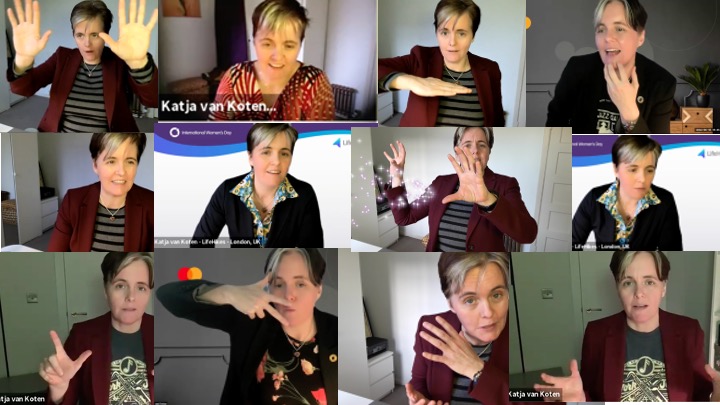
In 2022 I ran 136 virtual sessions.

I did not plan to learn what I did from that year. I thought I was delivering training. What I was actually doing, without quite naming it at the time, was watching the same patterns surface again and again across completely different teams, organisations, and topics.

The pattern that appeared most consistently was not about communication skills. It was about assumptions: the assumptions people carry about what good communication looks like, and the quiet pressure they put on themselves because of the gap between that image and what they actually do.

The clients often wanted the meatier topics. Challenging conversations, difficult feedback, high-stakes communication. And those matter. But what I kept observing was that the real difference was rarely made by the content of the session. It was made by smaller things.

One of those things was presence. Not mine as the facilitator, though that matters too. Everyone’s.

And by presence I do not mean high energy, or being visibly engaged, or performing enthusiasm. Some of the most present people in a room are the calm ones. The ones who observe carefully before they speak. The ones who ask the question no one else thought to ask. You need both in a team: the person who moves fast and the person who notices what the fast mover missed.

What I started asking, and still ask now, is: what is the energy you bring? Not as a judgement, but as genuine curiosity. Because when people understand their own energy and how to use it well, without burning themselves out trying to be something they are not, something shifts in how a group thinks and works together.

That understanding sits at the foundation of how I design my work now. Not the 136 sessions as a number, but what that volume of repetition made visible: the small things that consistently made a difference, and the structural patterns underneath all the variation.If I could say one thing to the version of myself running session one, it would be this: be present. It is over before you know it. And presence is not a nice-to-have. It is the work.

We have been taught that good eye contact signals confidence, builds trust, and shows you are listening. And there is something in that. But the story is more complicated than the advice suggests.

Oxytocin, the so-called cuddle hormone, is often cited as the reason eye contact builds connection. It does play a role. But its effects are more context-dependent than the self-help industry would have us believe. It works when there is already familiarity and safety. With strangers, or in high-stakes situations, sustained eye contact can increase anxiety rather than reduce it. The love hormone is more selective than advertised.

And yet we keep coaching people to hold eye contact as though it were a universal signal of presence.

Quality over quantity. It is one of my mantras, and nowhere is it more true than here. A moment of genuine eye contact at the right point in a conversation does more than sustained eye contact throughout. One feels like connection. The other can feel like pressure.

This matters particularly now. Many younger people have grown up with higher levels of social anxiety, and for them eye contact can feel genuinely difficult. Forcing it as a standard is counterproductive. It does not build presence. It builds performance.

Presence is not what your eyes are doing. It is whether your attention is actually there.

What signals presence to you in a conversation, if not eye contact?

For anyone curious about the research behind this:

On oxytocin and eye contact with familiar versus unfamiliar people: Frontiers in Endocrinology, 2021. https://www.frontiersin.org/journals/endocrinology/articles/10.3389/fendo.2021.629760/full

On the context-dependent effects of oxytocin and eye contact, including with strangers: Psychology Today. https://www.psychologytoday.com/us/blog/neuro-behavioral-betterment/202012/eye-contact-masks-biological-effects

On rising social anxiety in younger generations: Frontiers in Psychiatry analysis cited in All About Psychology. https://allaboutpsychology.substack.com/p/the-gen-z-stare

Jonathan Haidt’s The Anxious Generation has been one of those recently. It has sparked important conversations about young people, technology, and how our environments shape behaviour. One observation that stayed with me was his description of how children gradually disappeared from public spaces (the slow demise of the playground), and how much more life moved indoors.

Reading it prompted me to return to an earlier book of his: The Righteous Mind.

It was published quite some time ago, but it feels remarkably relevant when thinking about conversations, judgement, and how people change their minds.

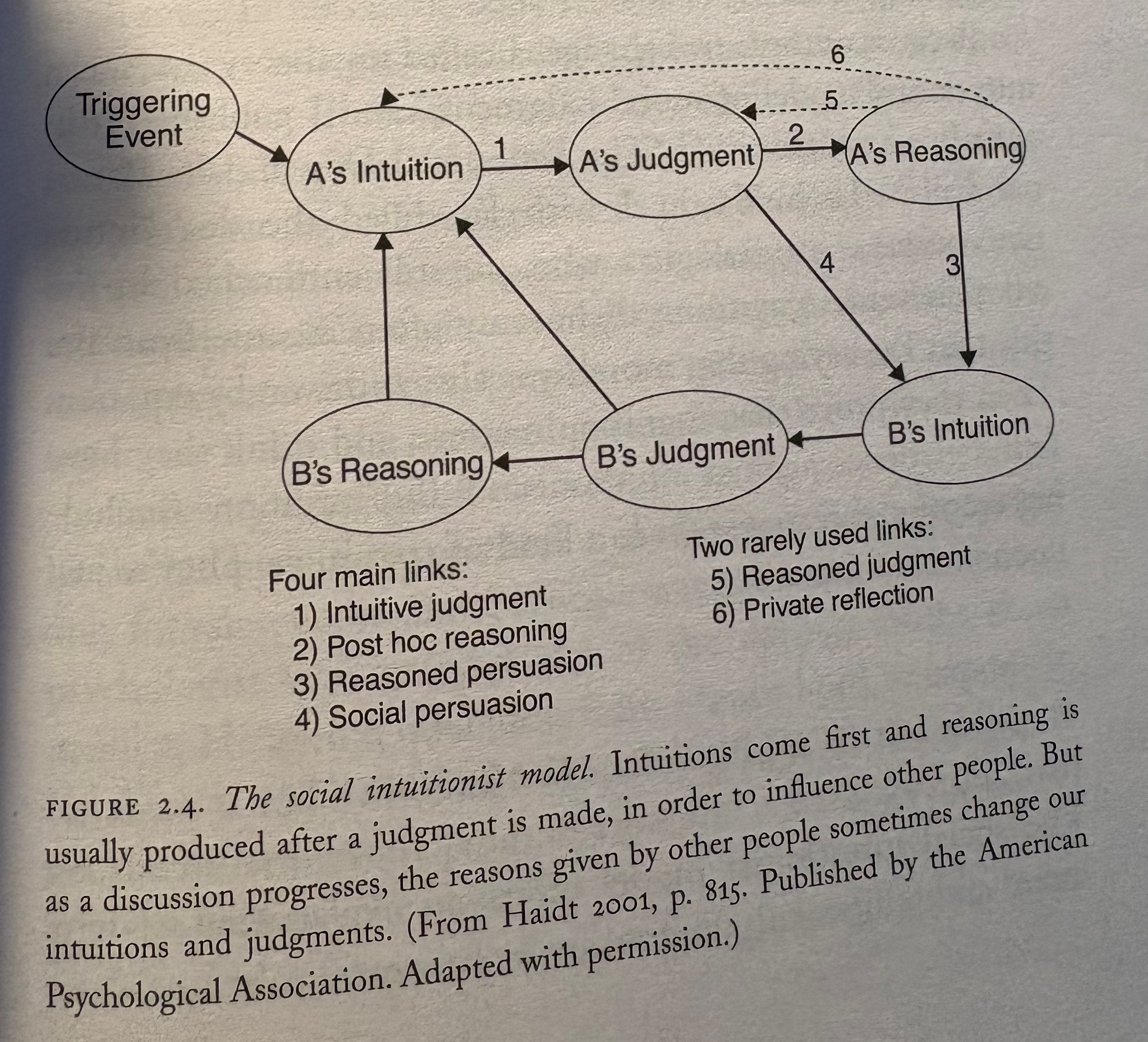
One idea in particular stood out again. Haidt describes the relationship between intuition and reasoning through the metaphor of the elephant and the rider. The rider represents our reasoning mind, while the elephant represents our intuitive, emotional responses. We often assume the rider is in charge. In reality, the elephant usually moves first.

I’ve been using that metaphor for years when working with teams around challenging conversations. When someone is strongly in their emotions, trying to reason your way through the situation rarely works. The rider cannot simply force the elephant to move.

What I appreciated in The Righteous Mind is how much deeper Haidt goes. He describes how our initial intuitions shape our judgments almost instantly, and how reasoning often follows afterwards, mainly to explain or defend the conclusion we’ve already reached. But there is an important twist to this. Change rarely happens through private reasoning alone. It happens in conversation. Someone asks a question, someone offers a perspective we hadn’t considered, and gradually our intuition shifts. Only then does the rider follow.

That idea resonates strongly with what I often see in teams. Better decisions rarely come from individuals reasoning harder on their own. They emerge from conversations where people feel able to question assumptions, challenge thinking, and explore different perspectives together. In many ways, that is the work I describe as Better Thinking Together; creating the conditions where conversation can genuinely expand how people understand a situation. Which makes the quality of those conversations incredibly important. Because if we want better thinking in organisations, we don’t just need better arguments. We need better conversations.

The diagram in the book illustrates how judgement, intuition and reasoning interact in discussion.

I’m curious: when have you experienced a conversation that genuinely changed how you saw something?

Someone is talking, and I am listening. And then, somewhere in the middle, my attention shifts just slightly. Not dramatically. But something pulls at the edge of my focus, and by the time I realise it, the moment has already moved on.

It reminds me of that feeling when you pass someone you know in the street, they say something, and you laugh along even though you have no idea what they said. And then you pray they do not come back to it.

The instinct in those moments is to respond as though you have fully heard. Because stopping to say “I am not sure I caught that properly” feels awkward, especially mid-conversation, especially when you have already appeared to engage (and especially when you are in a hurry).

But here is what I have noticed. When that moment passes without being named, something small gets left unresolved. And the signal that it happened usually arrives a little later. Someone sends an email asking a basic question that should already be settled. Or, more telling still, they ask for a summary of what was decided at the end of the conversation.

That request, innocent as it sounds, is often an early sign that clarity did not fully land. Not because anyone was careless. Simply because the conditions for it to land were not there.

The subtlest sign that a group does not have shared clarity is usually not confusion. It is that things are not moving. Decisions hover. Energy stays flat. People wait without knowing what for.

Different words mean different things to different people. But sometimes the gap is not even about words. It is about whether attention was genuinely present long enough for understanding to form.

What is your earliest signal that something has not landed in a conversation?