🧠 The teams with the highest individual IQs…
Often make the worst decisions.

If everyone thinks the same way, shares the same background, or has the same view, you don’t get better ideas. You get blind spots.

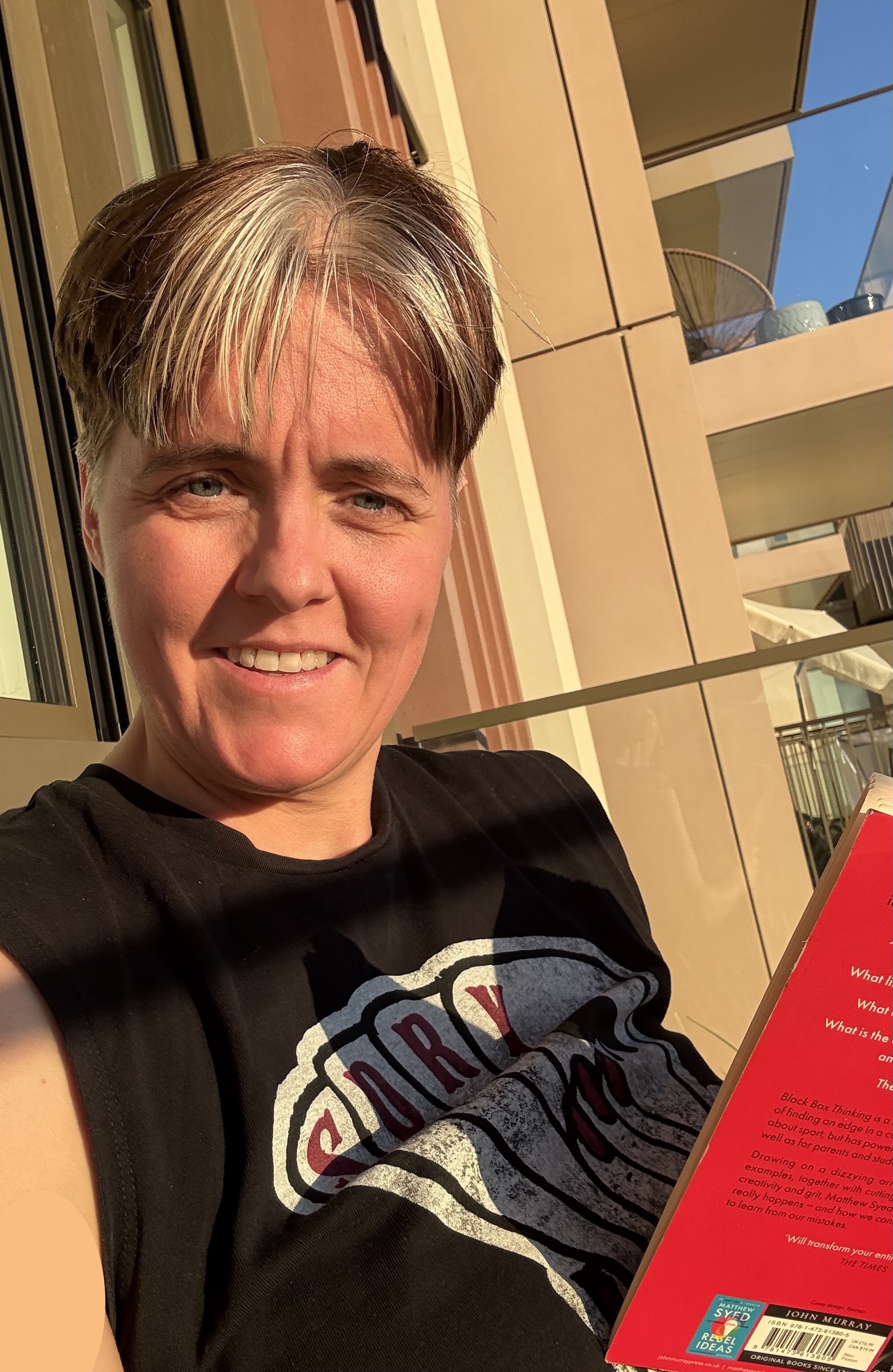
This is of the main point of Matthew Syed‘s Rebel Ideas, which I recently read again.
A few weeks ago, I shared thoughts on his other book, Black Box Thinking, about how we learn from failure.
Rebel Ideas feels like the perfect follow-up. It’s about how we learn from others, especially those who see things differently.

Here are a few ideas that stood out:

🧠 Smart individuals don’t guarantee smart teams
A team full of high performers can still make bad choices if they all think alike.
Diversity only helps if different voices are actually heard.

🧭 We need both depth and distance
Syed says real insight comes when we combine deep expertise with fresh perspectives.
It’s not one or the other, but both together that matter.
He shares the story of DEC computers — but it made me think of the Blackberry film.
They were so focused on what had worked before, they couldn’t imagine people wanting a phone without a keyboard.

⚠️ Secrecy hurts innovation
Some companies keep ideas hidden to protect themselves. But when they shut out new thinking, ideas stop growing.

📊 The problem with averages
This really stood out to me:
“When an average is used well, it brings together many insights.
But used badly, it forces one solution on everyone.”

And one line still sticks with me — especially now, when “diversity” is talked about more than ever, even as it feels more important than ever:

“Our species is the most formidable on the planet not because we are individually strong, but because we are collectively diverse.”

📚 If you’re interested in better decisions, innovation, or working well with others, this book is worth reading (or re-reading).

✈️ “Katja, what have you been doing this summer?”

Well… among other things, re-reading (yes, re-reading!) a book that’s just as powerful the second time around:
📘 Black Box Thinking by Matthew Syed.

I don’t often re-read books – there are simply too many still on my list. But thanks to a WhatsApp discussion with two wonderful colleagues I was reminded of Syed’s work, I picked this one back up. And I’m so glad I did.

I had forgotten how striking the opening chapter is, with the story of Elaine Bromiley, who died during what should have been a routine anaesthetic. This wasn’t just a tragic mishap, it was the result of a system that failed to notice and respond to mounting danger.

And that’s exactly what this book is about: not just reacting to failure, but building cultures that learn from it. That celebrate iteration. That pause before blame. That evolve.

Some insights that hit home (again):
🔁 The paradox of success: it’s built on failure
🎯 The guided missile analogy; failure isn’t the opposite of progress, it is the mechanism of progress. Feedback is course correction.
🧠 We’re hardwired to oversimplify complex systems
⚖️ Winners need both innovation and discipline
⏸ Pausing before blame can change everything

And still just as powerful:

“Failure is simply the opportunity to begin again, this time more intelligently.” — Henry Ford

It’s not perfect, though. Syed credits the Ancient Greeks with initiating the idea that failure can be productive — and while that may be true in Western intellectual tradition, it’s too narrow a lens. Other cultures show similar thinking:
– In Ancient Egypt, the evolution from the Bent Pyramid to later designs shows clear adaptation and learning through trial.
– In Ancient Chinese philosophy, concepts like balance, reflection, and continuous refinement point to a mindset of growth through iteration — not shame.

🎯 Whether you’re in aviation, healthcare, education, or business — this book is a must-read (or re-read) for anyone serious about creating systems that improve over time.

👀 Next up: Rebel Ideas — a timely revisit to another Syed classic, and why diverse thinking isn’t just “nice to have,” but mission-critical.

📚 Curious: what’s a book you’ve re-read that hit differently the second time?

#BlackBoxThinking #LearningCulture #LearnFromMistakes #Facilitation

Have you ever found yourself mid-conversation thinking, “Wait… what are we really talking about here?”
That’s exactly the kind of moment Charles Duhigg explores in Supercommunicators — and why this book was such a timely read for me.
As someone who works closely with clients navigating challenging conversations, I found this framework immediately useful:

🧩 Duhigg breaks down communication into three types of conversations — practical, emotional, and social.
The key? First, figure out what kind of conversation you’re in. And know that it can shift — sometimes more than once — in a single dialogue.

Some highlights I’ve already put into practice:
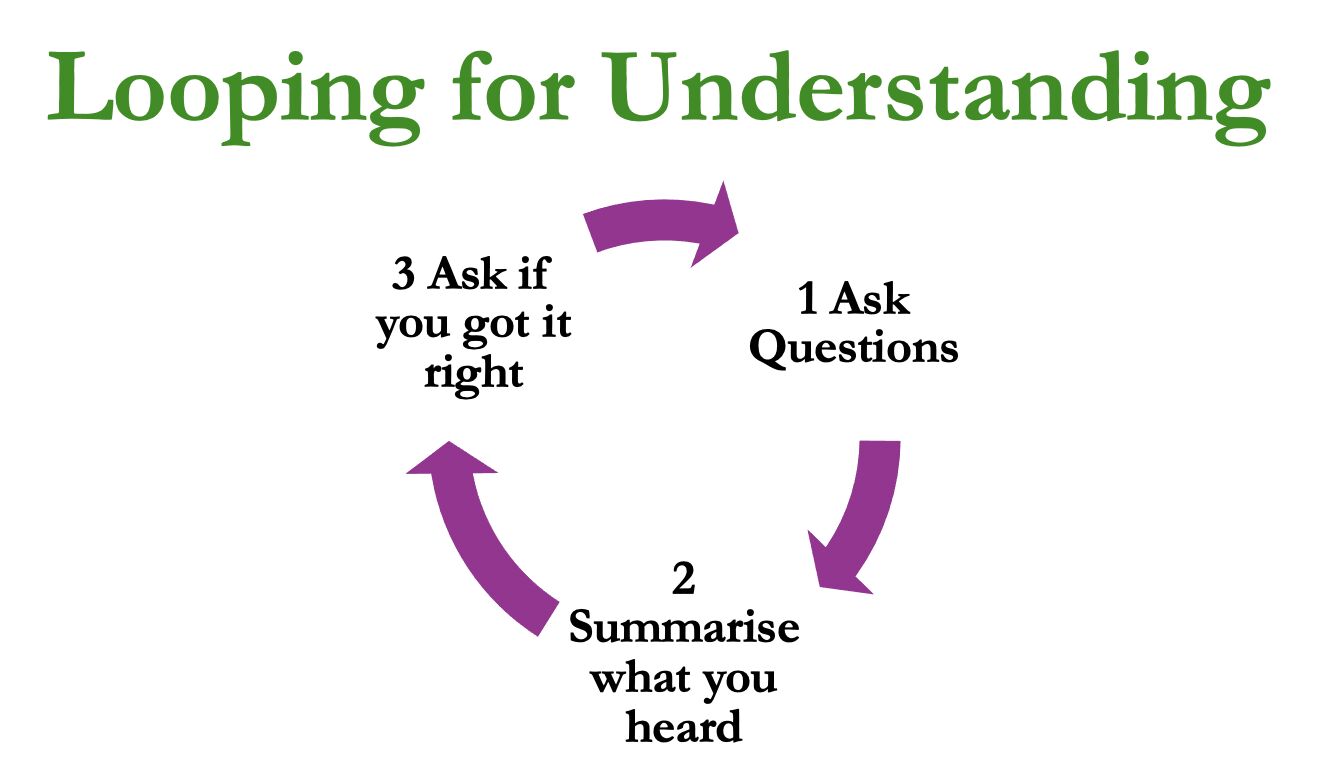
🔁 Looping for understanding — a central listening skill where we reflect back what we’ve heard to ensure clarity.
💬 As Yale psychologist Margaret Clark puts it:
“The best listeners aren’t just listening. They’re triggering emotions by asking questions, expressing their own emotions, doing things that prompt the other person to say something real.”
🧠 Prepare with purpose — even a few intentional questions beforehand like “What does this person really need?” or “What mindset do I want to bring in?” can shape the entire tone of a conversation.

📚 Supercommunicators is now firmly on my recommended list for facilitators, coaches, and anyone who wants to become a better conversationalist — especially when the stakes are high.

(see in link below to his TedTalk he did last year on the same topic: The science behind dramatically better conversations | Charles Duhigg | TEDxManchester https://youtu.be/lg48Bi9DA54?si=AYCzLBRJWhQu6c_h)

#Supercommunicators #CommunicationSkills #LeadershipDevelopment #TrustedAdvisor #Facilitation #ActiveListening

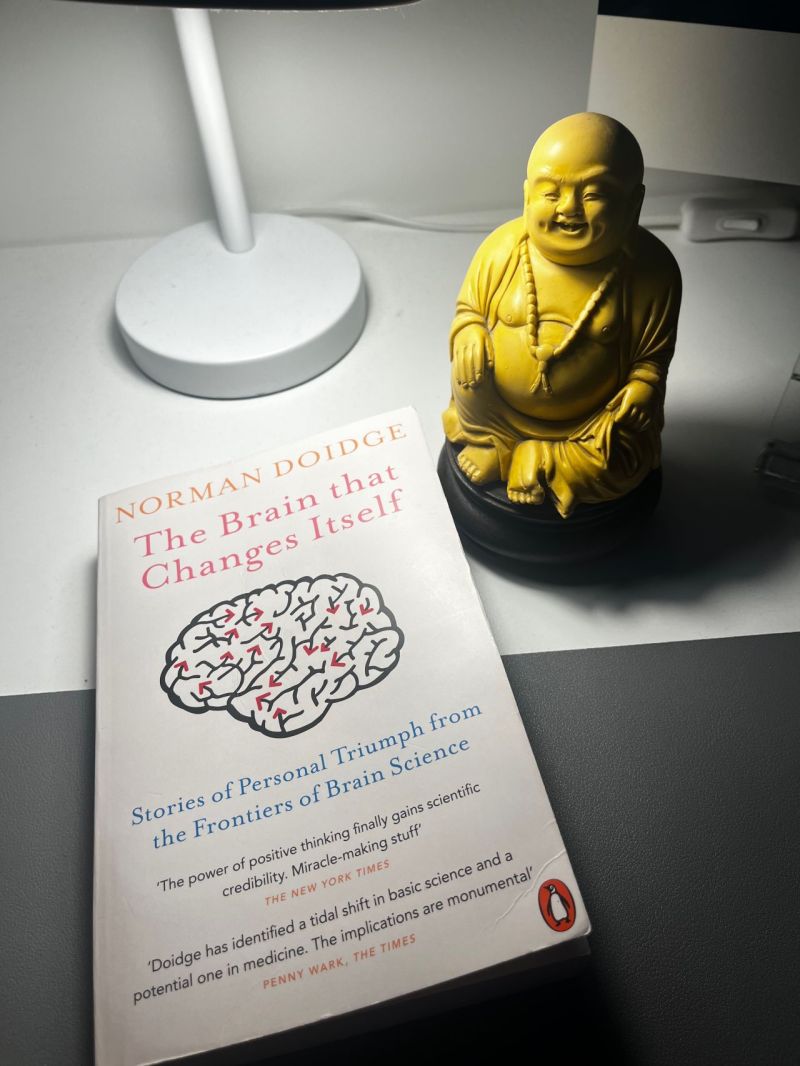
Earlier this year finished The Brain That Changes Itself by Norman Doidge, and it made me rethink how adaptable our brains truly are. As a Senior Communication and Leadership Development Facilitator & Coach, I’ve always been interested in neuroscience. This book offered some eye-opening insights that I wish I’d known—not just for the work I do, but on a much more personal level, especially when it comes to recovery.

Here are 3 things I learned that really resonated with me:

  1.  💪🧠 The Brain Can Rewire Itself for Both Communication and Physical Function
    One of the most powerful concepts in the book was how the brain can reorganise itself after an injury—not just for speech, but for physical movement as well. My mum had a stroke eight years ago, and was left partly paralysed, along with speech challenges. At the time, we were often told, “It is what it is,” but if I had understood neuroplasticity back then, I would’ve known that the brain doesn’t just accept damage—it can adapt. Whether it’s movement or language, other parts of the brain can step in to take over. Recovery is possible, and the brain has an incredible ability to heal, even when it seems like all hope is lost. 
  2.  🔄🧠 Repetition and Practice Literally Change Your Brain
    Neuroplasticity isn’t just about recovery—it’s about growth. Repeating tasks, whether learning new skills or practicing communication, physically rewires the brain. As a coach, I’ve seen this firsthand: consistent practice strengthens the neural pathways necessary for leadership and communication. It’s not just about putting in the hours—it’s about creating lasting change in how we think, communicate, and act. 
  3. 🌱✨Rest + Stimulation = Lasting Change
    The section on Transcranial Magnetic Stimulation (TMS) was eye-opening. It shows that with the right stimulation—and crucial rest—the brain can make permanent changes. This mirrors what I see in leadership development: true growth often comes not just from pushing hard, but from taking time to reflect, rest, and let new skills integrate. 

These insights really hit home for me, especially in the context of my mum’s journey. I believe it could have made a world of difference in her recovery. The brain’s capacity to adapt is real, and that’s something we can all take into our own lives—whether we’re recovering from an injury or working on personal growth.

#Neuroplasticity #LeadershipDevelopment #Coaching #PersonalGrowth #Neuroscience #ProfessionalGrowth #TMS #TheBrainThatChangesItself

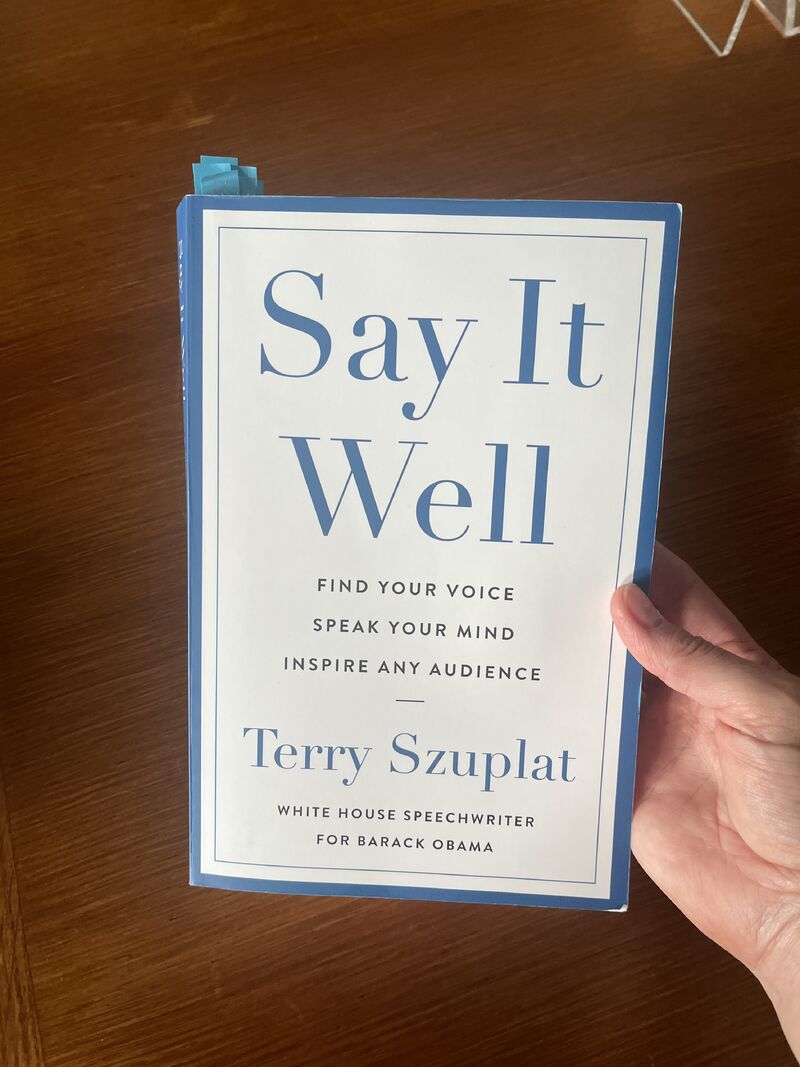
A sign how much I enjoyed a book are the sticky notes after I finished reading it… see here my copy of Terry Szuplat’s Say It Well.

It’s so wonderful to read on a topic I suppose to know *something* about and getting all inspired and excited again! There is a lesson here: always be open to learn and expand your horizons, especially on topics you’re familiar with.

Not just what the book teaches us on communication (and it’s a LOT) but also how.
Terry takes readers on a journey from the conception of a speech or presentation to the delivery, with anecdotes from the Obama White House, his own story (beautifully vulnerable) and presentations from other speakers (perhaps sometimes lesser-known speakers, but no less impactful!) –  I found it easy to read… and difficult to put down.

Some of the highlights for me:
* Scope it out – 10 questions to ask before any speech, I especially love the question ‘what do we (speaker and audience) have in common?’
* What a speech really is…  a performance, but “the ability to deliver the performance that only you can deliver”.
* Follow the BBQ rule (if you don’t say it in at a BBQ with friends don’t say it in a speech)
* The three questions to determine to use a statistic in a speech or not
* And finally: the power of hope, the only way to end a speech: that progress is possible, with a cautionary note on ‘being disciplined’

Highly recommended!

#BookRecommendation #CommunicationSkills #EffectiveCommunication #SpeechWriting #SayItWell 

https://www.theguardian.com/commentisfree/2021/mar/15/zoom-video-calling

Yes, part of the dreaded ‘zoom-fatigue’ is the constant looking at yourself. It’s like you’re walking around with a mirror all the time.

Hiding self view does help. To avoid the urge to turn the self view back on, like the author of this article, make sure you position yourself well before you hide your self view.

Are you ‘filling the frame’? Is your background not distracting? Is there enough light on your face? If the answers are yes, you can turn off that self view and focus on the meeting instead.

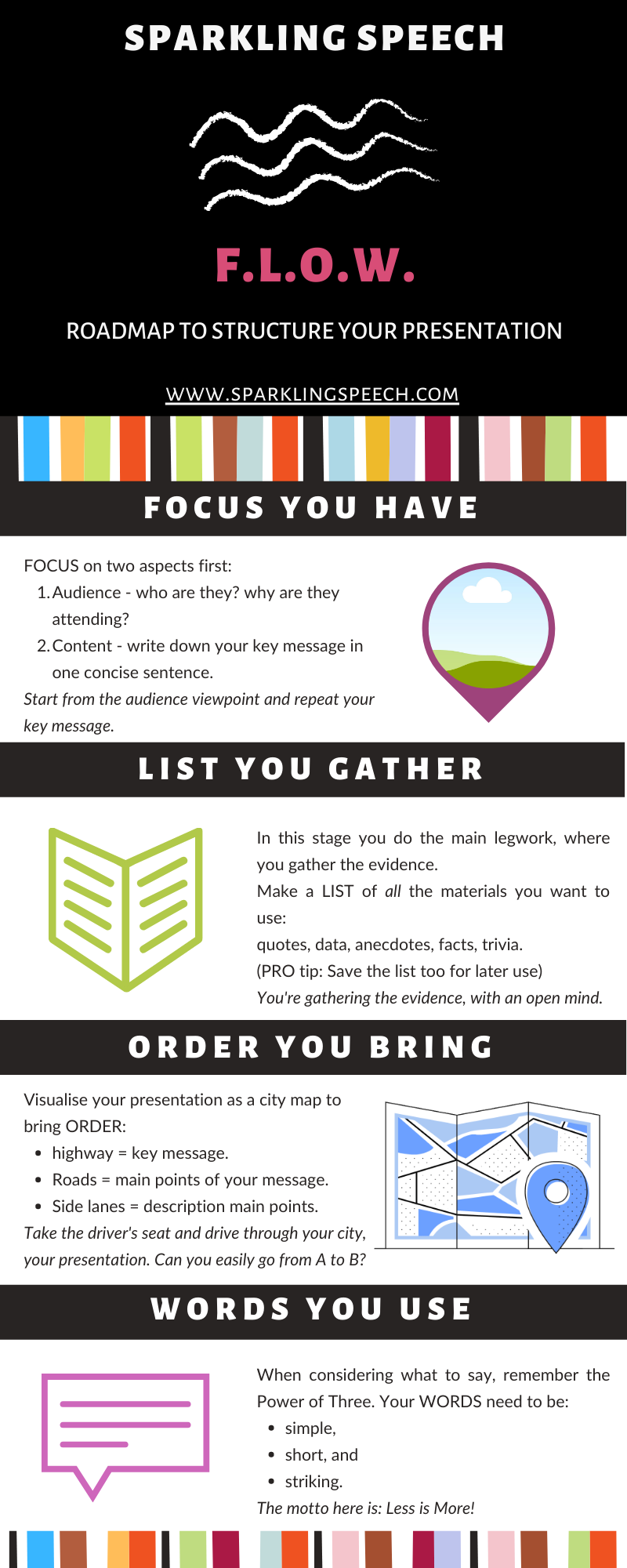
Focus you have

List you gather

Order you bring

Words you use

FLOW is a simple roadmap I developed over the years to structure any presentation. Last post I looked at the creative part of FLOW – Focus and List. See the blog post here: FLOW – part 1: Creative Flow

Now it’s time for the structural FLOW, the Order you bring and the Words you use. Fasten your seatbelts!

Order you bring

Imagine a presentation as a city roadmap with a highway running through it, and roads and side lanes:

  • Your highway is your key message,
  • The roads are the main points of your message, and
  • The side lanes are descriptions of each of your main points.

Don’t take your audience to far off the highway on the side lanes or they might get lost!

This is the stage to get your red marker out and be brutal. It’s where you sometimes have to ‘kill your babies’. We all have them; a favourite anecdote you can’t wait to share, a fact you just want to explain in a little more detail, clever points you want to make. Ask yourself: Will this lead back to my highway/key message? Will people get lost if I don’t tell them this? This stage of preparation is by far my favourite. Here you show some real character, what matters most to you? It’s content over performing. Do I want to look smart, or be meaningful?

All roads need crossroads and junctions, as does your presentation. How does it all link together? Does it all link together?
Rule of thumb here is that if you can’t follow it, your audience certainly won’t be able to follow it either. Take the driver’s seat and drive through your city, your presentation. Make sure you can easily drive from one point to another. You might want to say it out loud at this stage.

Words you use

For the Words you use you apply the Power of Three: make sure the words you use are simple, short and striking. Not only for your audience to understand, but also for you to pronounce. Fancy words have an habit of making us trip over them. Sure you might sound clever, but ask yourself what is more important; that your message comes across or that you sound clever? Use an online Thesaurus (like thesaurus.com) for useful synonyms of words that may be hard to understand and/or pronounce.

Less is more is the motto of this stage. Here you are sharpening the saw. Get ready for practicing the delivery (did you think you could get away without it? ;-))

This doesn’t mean that it needs to be perfect and finished once you start practicing your delivery. In fact as you practice it out loud a couple of times you will notice some inconsistencies. It shouldn’t take you long to fix these, as you have your framework in place. A framework you’ve built using FLOW.

For a quick overview – check this infographic of FLOW and let me know how you’re getting along.


In a month’s time the eyes of the world would have been upon Tokyo. After years of preparations the flame would be lit above the Japan National Stadium. Unfortunately we need to wait for another year.

Once we do and we marvel at the athletes achieving Olympic glory (and those who do not!) it always strikes me that those moments of glory are just that, moments. While the time it has taken them to get to that stage… The hours, days and months of training.

I’m not suggesting presentations require that much preparation in absolute terms. Relatively though the time we need to prepare for a presentation far outweighs the time it takes to actually deliver it. And after all that how frustrating is it when we still don’t get our message across?

If you look at the reasons why we don’t get our message across it’s often because our presentations lacks structure. This means how you say what you want to say concisely, powerfully and effectively. In the next few weeks I share with you a simple step by step process I developed over the years, FLOW, to structure presentations. Whether it’s an 1 minute intro, 5 minutes overview or an 20 minutes keynote speech, you can use FLOW.

It’s like a roadmap on how to structure your presentation for highest possible impact. In short, when preparing for a presentation the most important elements are the Focus you have, the List you gather, the Order you bring and the Words you use, in that sequence.

One of the benefits of using this roadmap is that it makes your message clearer. And once the message is more clear, the audience will feel more invested into it. And you as speaker will feel more confident as a result too. Using this roadmap I’ve been able to tackle a variety of topics, using many presentation formats.

The first two (F and L) I call the creative FLOW (yes that includes lists!), the other two (O and W) are the structural FLOW. This post focuses on the creative FLOW, the Focus you have and the List you gather.

Focus you have

Before you even start to think about the fabulous things you want to say, you need to ask yourself: who is my audience? Why are they listening to you? What do they hope to get out of this presentation?

This doesn’t mean you have to please everyone, you can’t. Your presentation would be too generic and bland. It does mean that you need to tailor your speech to the audience needs.

Only once you’ve got that crystal clear you can look at the second aspect of F: the content, your message. Can you say what you have to say in one sentence?

Remember the saying: 

“if you can’t say it in a sentence, you can’t say it in an hour” 

If you have to narrow it down to one key sentence – what is it that your message? Make sure you repeat that sentence throughout your presentation. This is the key take away for your audience.

List you gather

Now it’s time for the legwork of your preparation: your research. At this stage you are just gathering information, statistics, stories, trivia, quotes. You are NOT determining yet what’s in and out. Try to be as free and open as possible. That’s why Lists are part of FLOW. You’re not yet structuring it, you’re gathering the evidence with an open mind.

With a presentation of a 1000 words I usually end up with 1500 words after this stage. That’s absolutely fine, in fact it’s perfect. It allows you to shift through these and really cherry pick what is best. Only when you start ordering them you see new connections, and better ways you can bring it all together, but I’m getting ahead of myself.

What can you do with all the leftovers I hear you wonder? Well that’s why I have a Moleskine, several now after a decade! This stage usually takes longest, and if done properly will leave you with more material for later use.

“Give me six hours to crop down a tree, and I will spend the first four hours sharpening the axe.” A. Lincoln

Next week we look at the second half of FLOW, when we ‘hit the road’ with O and W.

To be continued!

Psst…

Check out this video I did for the English Speaking Union for their #esufestivalofspeaking: Train your Brain – Next time you’re presenting not only focus on your audience and message, but also on your strengths as speaker! 🙂

Walking through the office I felt my blood boiling, and it showed. When my coach approached me on the hallway he pulled me in the next available meeting room. He shut the door just in time. After ‘I cried my eyeballs out’ (as a friend would eloquently put it), I took a breath and all the frustration came out in one long stream. I was frustrated with myself to be precise. “I just can’t do this!”

I don’t know what it was about, but I still remember what my coach said to me: “we always focus on what we can’t do, or don’t do right, instead of what we can”.

That in itself is not so surprising. It’s how we are evolutionarily wired. Our minds naturally focus on the bad and discard the good. It was much more important for our ancestors to avoid threats than to collect rewards. Even though we are not in the savannah being chased by wild animals anymore, our brains have not yet caught up with that.

This plays out in many peculiar ways in our daily lives. Take for instance how we perceive ourselves, how we give ourselves feedback. In our modern virtual world video calling has become the norm. Before you log in to your Zoom meeting it gives you the ability to check your camera. Go back to the last time (probably today!) you did this – what is the first thing you notice? ‘Gosh I look tired!’ ‘That light really doesn’t work!’ ‘I should have…’  We are so used to look at what is not good. It’s called negative thinking, and it’s proven it has a negative impact on your health and well being. So what to do?

Acknowledging is the first step, being aware that you do it. Also notice that it is the first thought that comes up in any given situation. Try to be neutral about it. Don’t overshadow a negative thought with another negative one. ‘I’m doing it again!’ Give yourself some slack, everyone has these thoughts.

Try to take a step back, observe, and ask yourself what can I think instead? It doesn’t  mean you need to run around like Mohammed Ali I’m the greatest! (unless of course you are ;-)). Honesty and sincerity are vital. What is good about this situation? What am I going to contribute to this meeting? What is my mindset, my strength?

That’s exactly what my coach did when he made that comment. That comment shifted my mindset. I still have negative thoughts, everyone does, so what. Nowadays I’m able to take a step back, notice it and move beyond it. 

What if I fall? Oh, but my darling, what if you fly?  Erin Hanson

“I always know exactly what to say after an important meeting, not during a meeting!”

Does this sounds familiar?

I can not count the times clients mentioned this to me. A feeling of not really participating in a (virtual) meeting if you don’t speak. Of course it’s important that you make your voice heard, that your brilliant ideas are out there. And yet…

I always ask my clients: how many people on average are attending those meetings? Usually it’s around 8. Imagine they are all talking, all the time. What will you get done? Nothing. So what else is needed? People who listen, ask questions, pay attention to what happens in the (virtual) room. Not just sending, but receiving as well.

We all know the saying: people are listening to respond not to understand. In a world of constant rush and (learned!) need to be assertive and to speak up, to be able to truly listening to what is being said, is a rare skill indeed.

By challenging their mindset my clients are able to revalue what they are contributing to the meeting when they pay attention, and listen. This skill is called active listening.

What else can you do during the meetings you attend, when you’re listening? You can ask questions! Remember the best questions are the shorter questions. Ask your colleague to clarify points they are making, to sharpen their argument, or to make them think just a little bit different about a challenge they face. Not only will this help them (and the group) it will make them feel heard. And that will give you credibility too. So when you are ready to make your point, they are ready to listen too!

Of course now that we are all forced to slow down, what is curious is that a lot more people are catching up with the delicate skill of active listening. People start to observe more, the smaller things in life are becoming more important. I sincerely hope we can keep some of this, once lockdowns are slowly lifted. To find the right balance of being able to make your point and also to listen and be all ears.

“When you talk you are only repeating what you already know – but if you listen you may learn something new”

Dalia Lama