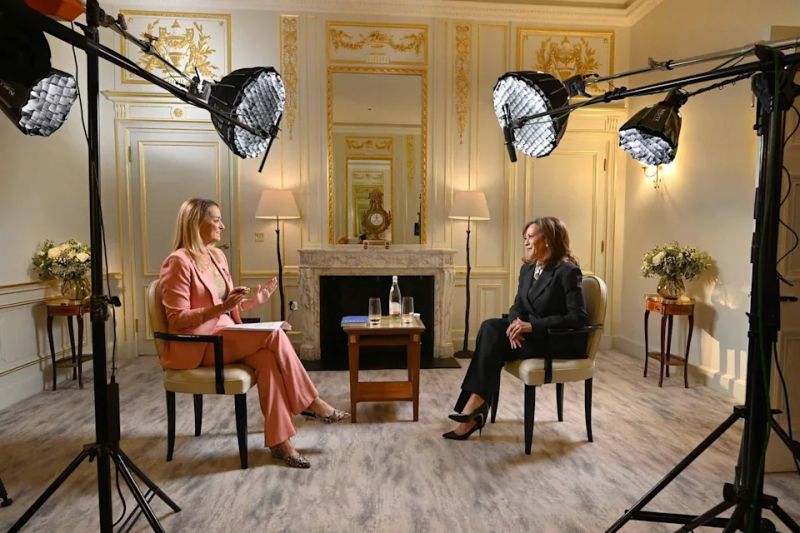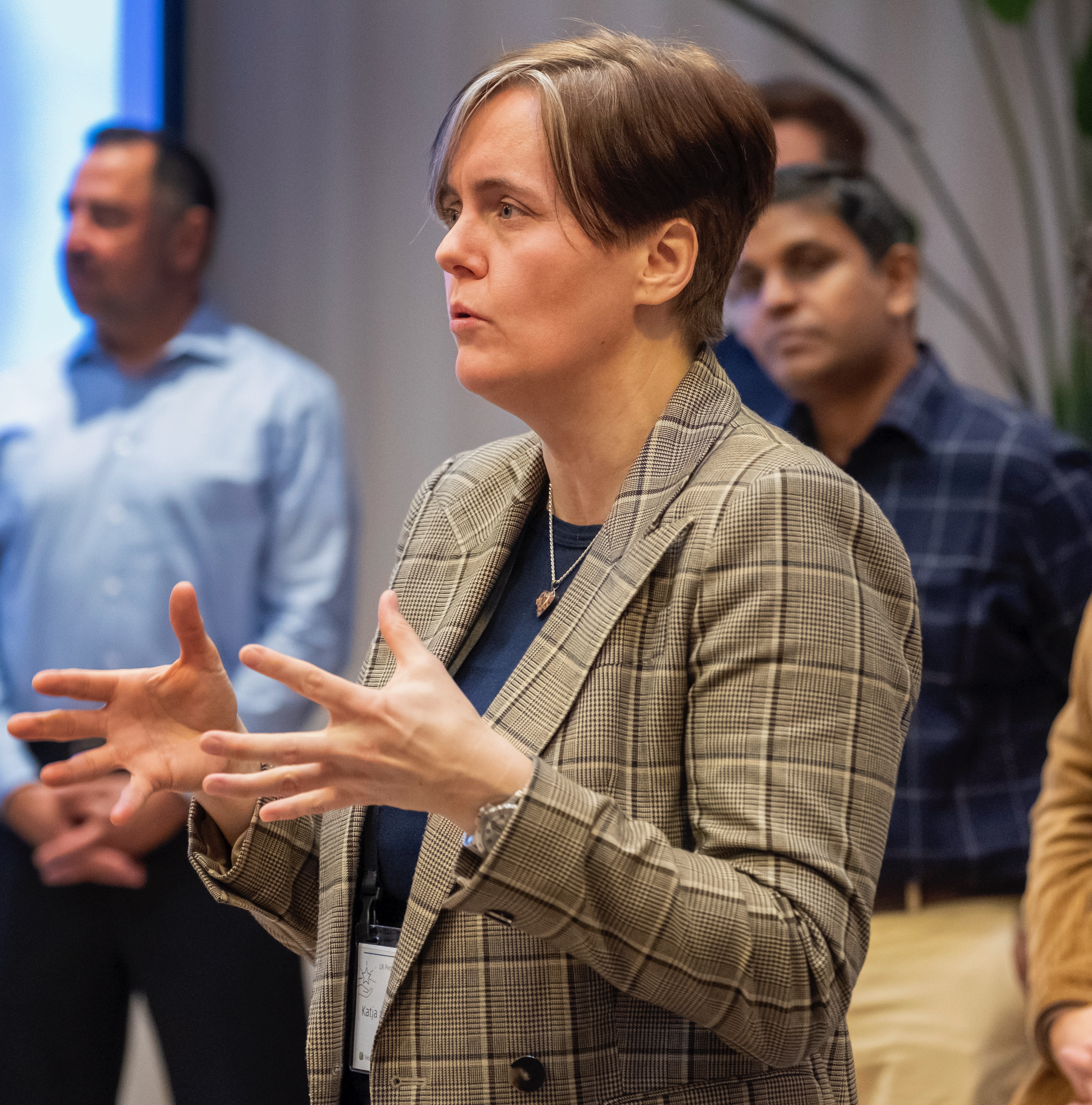
A few weeks ago, Kamala Harris was interviewed in London.
At one point, she was interrupted several times.
She didn’t raise her voice or rush her words.
She simply said, “Let me finish.” And paused.

Calm. Clear. Certain.

It wasn’t the first time; back in 2020, during the Vice-Presidential debate, she did something similar: “Mr Vice President, I’m speaking.”
Different moment, same presence.
She stood her ground: respectfully, firmly, and with grace.

That’s the power of consistency and that’s where trust begins.
When people see you show up with the same steady tone, the same clarity, the same calmness (even under pressure) they know what to expect from you.

And that’s often when it matters most in moments of tension.
When voices overlap, deadlines tighten, or opinions clash, consistency becomes a form of trust.
It signals safety, reliability, and respect, the sense that “we can disagree, but we’ll get through this together.”

The same is true in how we work, communicate, and collaborate every day.
When someone listens, follows through, or keeps their voice level even when discussions heat up, others lean in instead of tuning out.
Trust isn’t built in big moments, it’s earned through small, repeated micro-habits that show reliability over time.

In the framework I’ve been sharing (S for Small, H for Hook, I for Intentions, F for Flexibility, and now T for Trust) every shift adds up.
Because real collaboration starts when people feel steady in each other’s presence.

💡 What small, consistent actions build trust in your meetings or team?

#Communication #LeadershipDevelopment #Trust #Consistency

KoConsultancy Katja van Koten SHIFT 25

I recorded this right after a training in Lisbon just outside the castle, in a quiet corner away from the crowds.

https://youtube.com/shorts/tmVTLWgsuLg?feature=share

It reminded me how much the small things matter in communication.
Choosing a calm spot. Checking the light and sound. Taking a breath before you begin.

Over the past few weeks, I’ve been sharing moments from the framework I’m developing (Small shifts, Hooks, and Intentions) the micro habits that make communication stick.
This week, it’s about Flexibility: not just how we adapt our tone, timing, or style, but how we prepare to show up.

Because the way we set ourselves up before we speak often shapes how clearly others hear us.

💡 How do you prepare yourself or your space before an important meeting or presentation?

(And yes next week, we’ll reach the final letter 🙂)

#Communication #LeadershipDevelopment #Flexibility

A mentor once told me that, someone who taught me a lot about coaching, facilitation, and what it really means to be present and intentional in the room.
It’s one of those sentences that stays with you because it keeps proving itself true.

We all say we value feedback but too often it’s wrapped in niceties:

“That was great.”
“You did really well.”
“Loved it.”

Kind? Yes. Helpful? Not really.

Research from Harvard and Gallup shows that motivational feedback (clear, specific, and forward-looking) has a far greater impact on engagement than generic praise.

In one organisation I worked with, “good feedback” was everywhere.
The problem? Nobody actually knew what made something great so the learning stopped there.

Over time, those well-intentioned words became hollow.
Apathy crept in, silence followed, and the energy in meetings started to fade.

The shift is simple, but powerful:

When you give feedback, name the behaviour and the impact.

🟣 “When you paused before answering that question, it made your message clearer and more confident.”

Specifics turn words into action. They rebuild energy and trust, two things every team needs more of.

This is exactly what I mean by a small shift; one moment of awareness that can change how a conversation lands.
It’s also the S and H in the framework I’ve been developing around everyday communication habits that create real change. I’ll be sharing more about it soon.

💡 Hook:
Think of one meeting you’re in today; where could you make your feedback just a little more specific?

#Communication #Feedback #LearningAndDevelopment #TeamCulture #CoachingSkills #SmallShifts #TrustAtWork #HumanConnection

You know those meetings where everyone nods, but the silence feels heavy?
A decision gets made and we quickly move to the next point, but something hangs in the air.

I’ve been in those rooms. Everyone seems to agree, but you can sense unspoken thoughts beneath the surface.
Not open disagreement more like quiet uncertainty that lingers after the call ends.

It’s easy to think, “It’s fine,” or “Maybe it’s just me.”
But that kind of silence can quietly create distance between people, ideas, and collaboration.

Sometimes you can’t address it in the moment.
But afterwards, even a short 1:1 can make a real difference:

“That meeting covered a lot; I wondered what stood out most for you afterwards?”

No judgement. Just curiosity.
Those small check-ins often open conversations that would otherwise stay unsaid.

That’s one reason I’ve been developing a simple framework around everyday communication habits that rebuild connection and clarity. I’ll be sharing more about it soon.

#Communication #TeamCulture #HumanConnection #LearningAndDevelopment #SmallShifts #Collaboration #WorkplaceCulture #TrustAtWork

I’ll admit it: I first picked this one up because of the title 🫣. But what I found was a powerful story about Annie Besant’s fight for reproductive rights in the 19th century.

The opening words could just as well be written today:

“I believe that the discussion will be put down if Knowledge is suppressed by force… Come what may, this battle must be won.”

It’s striking (and a little sad) how current those words still feel.

What stood out to me was how central communication was to her story. Besant defended herself in the King’s Court (one of the first women ever to do so) and became a prolific public speaker. The courage to speak up, to keep speaking even when the cost is high, is what carried her cause forward.

Her closing words say it best:

“I risk my name, I risk my liberty… it is not without deep and earnest thought that I have entered into this struggle.”

A reminder that words can be more than conversation; they can be action.

Sometimes doing something a little different (picking up an unexpected book, following a thread of curiosity) sparks insights you didn’t expect. That’s how growth begins: in small, human shifts.

This connects closely to a framework I’ve been developing on small communication habits, I’ll be sharing more about that in the coming weeks!

👉 Have you read a book recently that surprised you and stayed with you?

#Communication #AnnieBesant #BookReview #LearningAndDevelopment #SmallShifts

🧠 The teams with the highest individual IQs…
Often make the worst decisions.

If everyone thinks the same way, shares the same background, or has the same view, you don’t get better ideas. You get blind spots.

This is of the main point of Matthew Syed‘s Rebel Ideas, which I recently read again.
A few weeks ago, I shared thoughts on his other book, Black Box Thinking, about how we learn from failure.
Rebel Ideas feels like the perfect follow-up. It’s about how we learn from others, especially those who see things differently.

Here are a few ideas that stood out:

🧠 Smart individuals don’t guarantee smart teams
A team full of high performers can still make bad choices if they all think alike.
Diversity only helps if different voices are actually heard.

🧭 We need both depth and distance
Syed says real insight comes when we combine deep expertise with fresh perspectives.
It’s not one or the other, but both together that matter.
He shares the story of DEC computers — but it made me think of the Blackberry film.
They were so focused on what had worked before, they couldn’t imagine people wanting a phone without a keyboard.

⚠️ Secrecy hurts innovation
Some companies keep ideas hidden to protect themselves. But when they shut out new thinking, ideas stop growing.

📊 The problem with averages
This really stood out to me:
“When an average is used well, it brings together many insights.
But used badly, it forces one solution on everyone.”

And one line still sticks with me — especially now, when “diversity” is talked about more than ever, even as it feels more important than ever:

“Our species is the most formidable on the planet not because we are individually strong, but because we are collectively diverse.”

📚 If you’re interested in better decisions, innovation, or working well with others, this book is worth reading (or re-reading).

✈️ “Katja, what have you been doing this summer?”

Well… among other things, re-reading (yes, re-reading!) a book that’s just as powerful the second time around:
📘 Black Box Thinking by Matthew Syed.

I don’t often re-read books – there are simply too many still on my list. But thanks to a WhatsApp discussion with two wonderful colleagues I was reminded of Syed’s work, I picked this one back up. And I’m so glad I did.

I had forgotten how striking the opening chapter is, with the story of Elaine Bromiley, who died during what should have been a routine anaesthetic. This wasn’t just a tragic mishap, it was the result of a system that failed to notice and respond to mounting danger.

And that’s exactly what this book is about: not just reacting to failure, but building cultures that learn from it. That celebrate iteration. That pause before blame. That evolve.

Some insights that hit home (again):
🔁 The paradox of success: it’s built on failure
🎯 The guided missile analogy; failure isn’t the opposite of progress, it is the mechanism of progress. Feedback is course correction.
🧠 We’re hardwired to oversimplify complex systems
⚖️ Winners need both innovation and discipline
⏸ Pausing before blame can change everything

And still just as powerful:

“Failure is simply the opportunity to begin again, this time more intelligently.” — Henry Ford

It’s not perfect, though. Syed credits the Ancient Greeks with initiating the idea that failure can be productive — and while that may be true in Western intellectual tradition, it’s too narrow a lens. Other cultures show similar thinking:
– In Ancient Egypt, the evolution from the Bent Pyramid to later designs shows clear adaptation and learning through trial.
– In Ancient Chinese philosophy, concepts like balance, reflection, and continuous refinement point to a mindset of growth through iteration — not shame.

🎯 Whether you’re in aviation, healthcare, education, or business — this book is a must-read (or re-read) for anyone serious about creating systems that improve over time.

👀 Next up: Rebel Ideas — a timely revisit to another Syed classic, and why diverse thinking isn’t just “nice to have,” but mission-critical.

📚 Curious: what’s a book you’ve re-read that hit differently the second time?

#BlackBoxThinking #LearningCulture #LearnFromMistakes #Facilitation

Have you ever found yourself mid-conversation thinking, “Wait… what are we really talking about here?”
That’s exactly the kind of moment Charles Duhigg explores in Supercommunicators — and why this book was such a timely read for me.
As someone who works closely with clients navigating challenging conversations, I found this framework immediately useful:

🧩 Duhigg breaks down communication into three types of conversations — practical, emotional, and social.
The key? First, figure out what kind of conversation you’re in. And know that it can shift — sometimes more than once — in a single dialogue.

Some highlights I’ve already put into practice:
🔁 Looping for understanding — a central listening skill where we reflect back what we’ve heard to ensure clarity.
💬 As Yale psychologist Margaret Clark puts it:
“The best listeners aren’t just listening. They’re triggering emotions by asking questions, expressing their own emotions, doing things that prompt the other person to say something real.”
🧠 Prepare with purpose — even a few intentional questions beforehand like “What does this person really need?” or “What mindset do I want to bring in?” can shape the entire tone of a conversation.

📚 Supercommunicators is now firmly on my recommended list for facilitators, coaches, and anyone who wants to become a better conversationalist — especially when the stakes are high.

(see in link below to his TedTalk he did last year on the same topic: The science behind dramatically better conversations | Charles Duhigg | TEDxManchester https://youtu.be/lg48Bi9DA54?si=AYCzLBRJWhQu6c_h)

#Supercommunicators #CommunicationSkills #LeadershipDevelopment #TrustedAdvisor #Facilitation #ActiveListening

Earlier this year finished The Brain That Changes Itself by Norman Doidge, and it made me rethink how adaptable our brains truly are. As a Senior Communication and Leadership Development Facilitator & Coach, I’ve always been interested in neuroscience. This book offered some eye-opening insights that I wish I’d known—not just for the work I do, but on a much more personal level, especially when it comes to recovery.

Here are 3 things I learned that really resonated with me:

  1.  💪🧠 The Brain Can Rewire Itself for Both Communication and Physical Function
    One of the most powerful concepts in the book was how the brain can reorganise itself after an injury—not just for speech, but for physical movement as well. My mum had a stroke eight years ago, and was left partly paralysed, along with speech challenges. At the time, we were often told, “It is what it is,” but if I had understood neuroplasticity back then, I would’ve known that the brain doesn’t just accept damage—it can adapt. Whether it’s movement or language, other parts of the brain can step in to take over. Recovery is possible, and the brain has an incredible ability to heal, even when it seems like all hope is lost. 
  2.  🔄🧠 Repetition and Practice Literally Change Your Brain
    Neuroplasticity isn’t just about recovery—it’s about growth. Repeating tasks, whether learning new skills or practicing communication, physically rewires the brain. As a coach, I’ve seen this firsthand: consistent practice strengthens the neural pathways necessary for leadership and communication. It’s not just about putting in the hours—it’s about creating lasting change in how we think, communicate, and act. 
  3. 🌱✨Rest + Stimulation = Lasting Change
    The section on Transcranial Magnetic Stimulation (TMS) was eye-opening. It shows that with the right stimulation—and crucial rest—the brain can make permanent changes. This mirrors what I see in leadership development: true growth often comes not just from pushing hard, but from taking time to reflect, rest, and let new skills integrate. 

These insights really hit home for me, especially in the context of my mum’s journey. I believe it could have made a world of difference in her recovery. The brain’s capacity to adapt is real, and that’s something we can all take into our own lives—whether we’re recovering from an injury or working on personal growth.

#Neuroplasticity #LeadershipDevelopment #Coaching #PersonalGrowth #Neuroscience #ProfessionalGrowth #TMS #TheBrainThatChangesItself

A sign how much I enjoyed a book are the sticky notes after I finished reading it… see here my copy of Terry Szuplat’s Say It Well.

It’s so wonderful to read on a topic I suppose to know *something* about and getting all inspired and excited again! There is a lesson here: always be open to learn and expand your horizons, especially on topics you’re familiar with.

Not just what the book teaches us on communication (and it’s a LOT) but also how.
Terry takes readers on a journey from the conception of a speech or presentation to the delivery, with anecdotes from the Obama White House, his own story (beautifully vulnerable) and presentations from other speakers (perhaps sometimes lesser-known speakers, but no less impactful!) –  I found it easy to read… and difficult to put down.

Some of the highlights for me:
* Scope it out – 10 questions to ask before any speech, I especially love the question ‘what do we (speaker and audience) have in common?’
* What a speech really is…  a performance, but “the ability to deliver the performance that only you can deliver”.
* Follow the BBQ rule (if you don’t say it in at a BBQ with friends don’t say it in a speech)
* The three questions to determine to use a statistic in a speech or not
* And finally: the power of hope, the only way to end a speech: that progress is possible, with a cautionary note on ‘being disciplined’

Highly recommended!

#BookRecommendation #CommunicationSkills #EffectiveCommunication #SpeechWriting #SayItWell